
Comparing Pet Insurance Plans

Your dog swallows a toy during playtime. Suddenly, you’re facing a $3,000 to $8,000 surgery bill for an intestinal blockage. These surprises hit fast, and they drain savings quick.
Pet emergencies like ER visits for bloat ($2,000 to $7,500) or poisoning ($250 to $6,000) add up. Most owners can’t cover them without stress. That’s where pet insurance steps in.
This post simplifies comparing pet insurance plans. You’ll learn key factors like coverage types, deductibles, reimbursement rates (70% to 100%), waiting periods, and annual limits. Plus, spot plans with useless coverage so you avoid overpaying.
Prices vary by your pet’s age, breed, state, and more. Dogs average $17 to $56 monthly; cats $10 to $32. Focus on details, not just the lowest premium. In short, get smart coverage that fits your furry friend.
Start with what you actually want covered (and what you do not)
When comparing pet insurance plans, first match coverage to your pet’s real risks. Basic plans split into accident-only or accident-and-illness types. Accident-only handles injuries from mishaps. However, it ignores common sicknesses. Full accident-and-illness plans cover both, which suits most pets.
Your choice hinges on age, breed, and budget. Puppies face more accidents, so cheaper accident-only works early on. Older dogs or breeds like Labs (prone to allergies) need illness protection. Cats with cancer risks benefit from full plans too. For example, a two-year-old Poodle might pay $55 monthly for solid coverage, but an eight-year-old jumps to $137 because vets spot issues more. Always check quotes for your zip code and pet details.
Real scenarios show the difference. A dog chases a ball and breaks a leg. Accident-only pays most of the bill. But if allergies cause ear infections later, you foot it alone. Full plans save families from those ongoing costs. In short, pick based on what hits your pet hardest.
Accident only vs accident and illness: which one fits your pet?
Accident-only plans cover sudden injuries. Think broken bones, poisoning from chocolate, or swallowed toys blocking intestines. These match the intro emergencies like your dog’s $3,000 surgery. Providers like some basic options keep premiums low, around $20 less monthly than full plans.
However, they skip illnesses. Ear infections, allergies, or cancer stay out. Your cat’s chronic bladder issues? Full price on you. Accident-and-illness plans from ASPCA, Embrace, or Trupanion add those. They handle meds, exams, even hereditary conditions with unlimited payouts in some cases.
Full coverage helps active young pets or risky breeds most. A golden retriever hit by a car gets surgery covered. Later cancer treatment? Still protected. Accident-only fits tight budgets for low-risk indoor cats.
Stuck deciding? Ask if your pet has breed illnesses or passed age five. Go full. Otherwise, start accident-only and upgrade later.
Wellness add-ons: helpful, or just prepaid vet care?
Wellness add-ons cover routine stuff, not emergencies. They include vaccines, annual exams, flea and tick preventives, sometimes dental cleanings. ASPCA and Embrace offer shots, heartworm tests, even spay or neuter. Expect $10 to $30 extra monthly.
These differ from core insurance. Base plans skip predictables like checkups. Add-ons act like prepaid vet visits. They shine if you always budget $400 yearly for puppy shots or cat dentals. One owner saved hassle when their add-on covered full vaccines.
But skip if costs beat benefits. Many plans reimburse only 80 percent, so you still pay some. Compare your average spend. If under the add-on price, pass. Predictable spenders win; occasional visitors lose.
For example, a tabby cat’s yearly exam and flea meds total $250. Add-on at $20 monthly pays off. Otherwise, self-fund.
Common exclusions that surprise people
Exclusions trip up new buyers. Pre-existing conditions top the list, like a limp before signup. Insurers deny those forever, even if symptoms fade. Breeding costs, pregnancy, and elective procedures like tail docking stay out too.
Prescription food and behavior training vary. Trupanion skips most training. ASPCA covers some dental illness but not routine cleanings without add-ons. Experimental treatments or cosmetics? Gone.
Waiting periods add hurdles, often 14 days for illnesses. Accidents start sooner.
Always read the sample policy and exclusions list. Marketing pages gloss over details. Check ASPCA’s full doc for acupuncture yes, but breeding no. Spot issues early saves regrets. Your breed’s quirks might hit exclusions hard, so quote multiple plans.
Compare the money parts that decide what you really pay
Premiums grab attention first. However, they don’t tell the full story when comparing pet insurance plans. Deductibles, reimbursement rates, and limits shape your real costs. Picture a $3,000 emergency surgery for your dog’s blockage. You pick the plan with the lowest premium.
Yet, a high deductible eats half the bill before coverage kicks in. Test plans against that same bill. You’ll spot winners fast. Most deductibles range from $100 to $1,000. Higher ones cut premiums but raise your upfront pay. Let’s break it down.
Deductibles: annual vs per-condition, and why it matters
Annual deductibles work simply. You hit the amount once per year, then coverage starts for all claims that year. Choose $250, and after paying that on your first bill, the rest reimburses. Providers like Embrace, ASPCA, Trupanion, and Lemonade stick to annual types mostly. They range from $0 to $1,000.
Per-condition deductibles reset per illness or injury. They sound good at first. But your dog gets ongoing ear infections. You pay the full deductible each time. That adds up quick. For example, three infections in a year at $250 each total $750 out-of-pocket before coverage. Annual caps it at $250 total.
Some plans offer diminishing deductibles. No claims for a year? The amount drops, say from $250 to $150. You save on future emergencies. This rewards healthy pets. Check Embrace for options. Always match to your pet’s history. Frequent issues favor annual.
Reimbursement rate and payout limits: the fastest way to spot a weak plan
Reimbursement rates pay back 70 to 90 percent of bills after your deductible. Trupanion sticks to 90 percent standard. Others like Lemonade let you pick up to 90 percent, or even 100 in spots. Higher rates cost more monthly, around $10 to $20 extra.
Annual limits cap total payouts per year, from $5,000 to unlimited. Per-incident limits hit single events. Unlimited lifetime coverage from Trupanion or ASPCA handles chronic issues without worry. It raises premiums 20 to 50 percent. Yet, high-risk breeds like French Bulldogs face big bills. Cancer or rehab can top $20,000 yearly. Unlimited pays off then. Low-risk indoor cats? A $10,000 limit saves cash.
Spot weak plans fast. Low reimbursement under 80 percent plus tight limits under $10,000 spells trouble. Your $3,000 bill at 70 percent and $5,000 limit pays $1,750 back after deductible. Compare to 90 percent unlimited. That jumps to $2,475. Pick based on breed risks.
What counts as the bill: exam fees, meds, diagnostics, and rehab
Coverage goes beyond surgery. Bloodwork, X-rays, and ultrasounds add up first. A $3,000 total might split as $500 exam, $800 diagnostics, $1,200 surgery, $500 meds. Plans reimburse most if eligible.
Exam fees often count fully. Prescriptions cover 80 to 100 percent. Hospital stays too. Rehab for hips enters some policies. Check dental illness; ASPCA includes it unlike routine cleanings. Alternative therapies like acupuncture vary. Embrace covers some. Orthopedic issues hit hereditary exclusions sometimes.
Read fine print. One plan skips exam fees. Your bill drops from $3,000 to $2,500 covered. That saves hundreds. Ask about meds and imaging. Full bills protect better.
A quick side-by-side example you can copy
Use this template for your quotes. Assume a $3,000 eligible bill. Start with same base: $40 monthly premium, $250 deductible, 80 percent reimbursement, $10,000 annual limit. Tweak one factor. See out-of-pocket change.
| Plan Variation | Premium | Deductible | Reimbursement | Annual Limit | Extras/Notes | Your Cost on $3k Bill |
|---|---|---|---|---|---|---|
| Base Plan | $40 | $250 | 80% | $10,000 | Standard | $550 ($250 ded + 20% of $2,750) |
| Higher Ded | $30 | $500 | 80% | $10,000 | Saves $10/mo | $800 ($500 ded + 20% of $2,500) |
| Better Reimb | $55 | $250 | 90% | $10,000 | +$15/mo | $400 ($250 ded + 10% of $2,750) |
| Unlimited | $65 | $250 | 80% | Unlimited | Chronic OK | $550 (same as base, future-proof) |
| Low Limit | $35 | $250 | 80% | $5,000 | -$5/mo | $550 (hits cap if more claims) |
Base math works like this. Subtract deductible: $3,000 minus $250 equals $2,750. 80 percent reimburses $2,200. You pay $800 total, insurer $2,200. Higher deductible cuts premium but spikes your pay. Unlimited shines later. Copy this. Plug your quotes. Exclusions matter too; base assumes all covered.
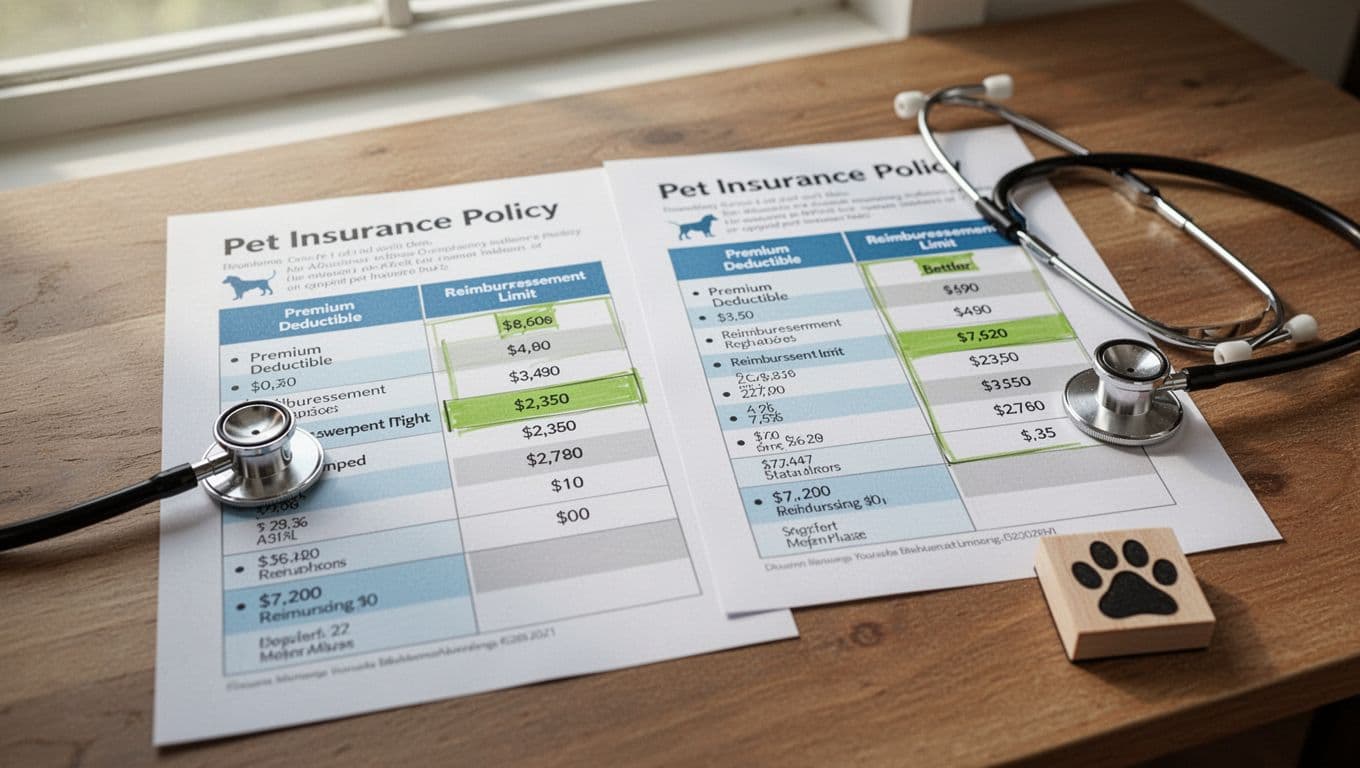
Check the fine print that decides whether claims get paid
Plans look great until a claim hits a snag. When comparing pet insurance plans, skim past the fine print at your own risk. These details control if your vet bill gets covered. Waiting periods delay protection. Pre-existing rules block old issues. Claim rules set speed and hassle. Providers like Embrace, ASPCA, Trupanion, and Lemonade vary here. Spot differences now. It saves headaches later.
Waiting periods and special rules for knees, hips, and hereditary issues
Accidents trigger coverage fast. Most plans start in 1 to 14 days. Your dog steps on glass? Protection kicks in quick. Illnesses take longer, often 14 to 30 days. Embrace gives two days for accidents but 14 for sickness. ASPCA waits 14 days for both. Trupanion offers about five days for injuries, 30 for illnesses. Lemonade skips accident waits but holds 14 days for illness.
Orthopedic troubles drag out. Knees, hips, ligaments face 6 to 12 months in many policies. Insurers add time to stop fraud. Embrace requires six months for dog knees or hips, but a pre-enrollment vet exam cuts it to 14 days. Trupanion demands 12 months for hip dysplasia if your pet is over six at signup. Lemonade sets 30 days for ortho. States don’t change this much. Providers set rules.
Enroll early. Symptoms make issues pre-existing. Sign up before limps appear. Healthy pets dodge long waits.
Pre-existing conditions and what “curable” can mean
Pre-existing means any sign before coverage starts. A cough or itch counts. Most plans exclude them forever. Chronic cases like arthritis stay denied. Curable ones differ. Some insurers cover if symptoms vanish for months. Expect six months symptom-free. AKC waits a full year.
Embrace and others define “curable” tightly. Your cat’s treated ear infection? It might qualify after no flares. Chronic diabetes? No chance. Switching plans rarely helps. MetLife covers some prior coverage elsewhere.
Check exact words. Policies spell out timelines and tests. Ask for sample docs. Vague terms bite later. Confirm before you buy.
Claim deadlines, reimbursement speed, and how you get paid
File claims soon. Deadlines run 30 to 90 days from the vet visit. Miss it, lose money. Submit itemized bills, medical records, injury photos, and your policy number. Apps speed it up. Fast claims need clean docs. No fuzzy scans.
Reimbursements take 5 to 30 days. MetLife hits five days. Others average 10 days. Some offer 24/7 telehealth. It cuts ER trips for minor issues. Chat with vets online first. Save cash and stress.
Direct pay to the vet vs reimbursement to you
You pay upfront in most cases. Then wait for reimbursement. That strains cash flow. A $3,000 surgery? Cover it first. Direct pay skips this. Insurers send cash straight to vets.
Trupanion offers it at partnered clinics. Others rarely do. Call your vet. Ask if they bill insurers direct. Confirm with your provider too. Networks matter. Assume nothing. Upfront hits hurt less with savings ready. Direct pay eases it when available.
Use your pet’s profile to pick the best plan for your budget
Your pet’s age, breed, and health shape the best deal when comparing pet insurance plans. Enter those details into quote tools first. Premiums swing from $24 monthly for cats to $95 for older dogs. Puppies pay around $40 for dogs; adults hit $44 to $56. Seniors climb higher because risks grow. Multi-pet homes snag 5 to 10 percent discounts too. Match your profile to smart choices below. You save time and cash.
Puppies and kittens: why earlier is usually cheaper
Sign up young to dodge pre-existing exclusions. A limp at age two stays covered later. Wait until age five, and that issue blocks claims forever. Costs rise fast too. Puppies average $40 monthly for dogs; kittens even less at under $20 often. Adults double that quickly.
Look for plans with higher annual limits over $10,000. They handle big accidents like swallowed toys. Pick strong accident coverage since young pets crash more. Congenital coverage protects breed quirks early, before they count as pre-existing. Start now. You lock in low rates for life.
Adult pets: balancing premium vs peace of mind
Adults need balance between monthly costs and emergency readiness. Ask yourself: what could you pay tomorrow on a $3,000 bill? Set your deductible there. A $250 amount fits most budgets; you clear it in one day from savings.
Then grab the highest annual limit you afford, like unlimited if possible. It covers allergies or infections that drag on. Reimbursement at 80 to 90 percent cuts stress. For example, a $50 premium with $250 deductible pays back $2,200 on that bill. Peace beats pinching pennies.
Senior pets and chronic conditions: when insurance may or may not pencil out
Seniors face steep premiums, around $95 monthly for dogs. Exclusions hit harder on arthritis or heart issues. Coverage shrinks because claims spike. Still, compare quotes closely.
Go accident-only if illness risks loom; it costs less at $17 average. Raise deductibles to $500 or more. That drops premiums 20 percent. Or skip insurance. Build a pet emergency fund instead, $200 monthly into savings. Test numbers. If claims top premiums yearly, fund wins.
Multiple pets, exotics, and special cases
Multi-pet families score discounts of 5 to 10 percent per extra animal. Quote all together. Savings stack on two dogs or a dog-cat pair.
Exotics like birds or rabbits? Many plans skip them. Dogs and cats rule 100 percent of policies. Ask about species covered, network vets, and special waiting periods. Some providers handle reptiles; most don’t. Confirm upfront. No shocks later.
A simple checklist for comparing pet insurance plans in under 30 minutes
Grab quotes fast with this steps. It takes you from confusion to choice.
- Get three quotes using your pet’s age, breed, and zip code.
- Match deductibles ($250?) and reimbursement (80 percent+).
- Compare annual limits; aim high or unlimited.
- Read top exclusions like pre-existing or orthopedics.
- Confirm waiting periods, especially for illnesses.
- Check claim process: app-based? Direct vet pay?
- Scan customer service: fast payouts? 24/7 line?
Done. Print or screenshot it. Your best plan fits now.
Conclusion
You now hold the roadmap for comparing pet insurance plans. Start by picking coverage that fits your pet’s risks, like full accident-and-illness for active dogs or basics for indoor cats. Next, align deductibles, reimbursements, and limits to your budget, so a $3,000 surgery leaves you with peace, not panic. Then, dig into fine print on waiting periods, pre-existing rules, and claims. Finally, select the plan that matches your pet’s age, breed, and your wallet.
Pets age fast, so check your policy yearly. Premiums climb as they do, around $44 monthly for dogs now, but switching early avoids new exclusions. A quick quote refresh keeps you covered right.
Back to Pet Insurance Explained


